
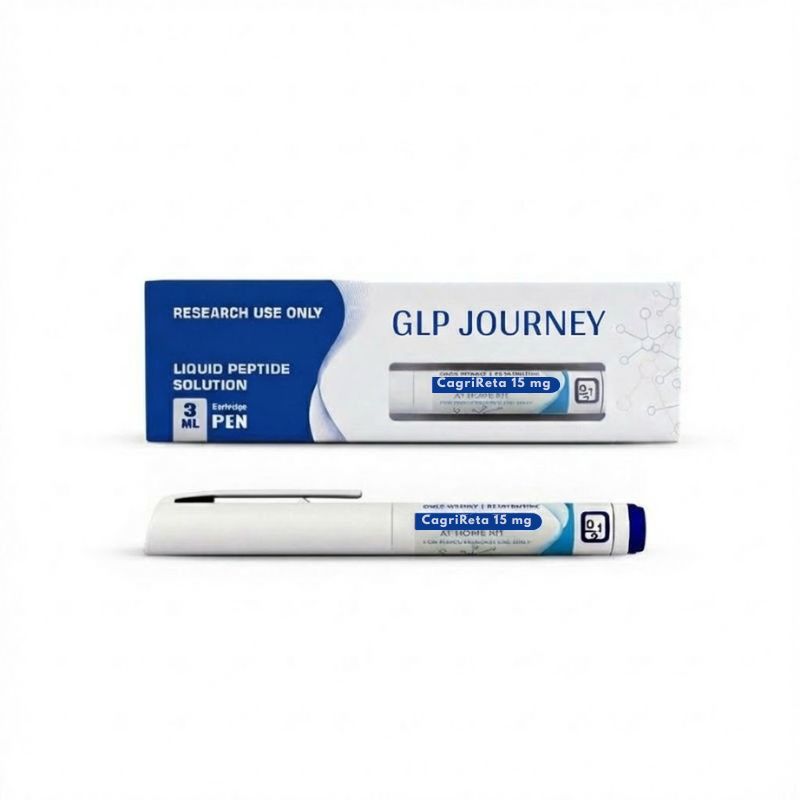
CAGRIRETA—15 mg
£200.00
Dual-Pathway Research Blend (Retatrutide + Cagrilintide)
Form: Lyophilised peptides blended into a 3 ml liquid solution
Total peptide content: 15 mg combined
Composition:
- Retatrutide — 10 mg
- Cagrilintide — 5 mg
Use: Research only
Built for Interaction, Not Intensity
CagriReta wasn’t created to chase extremes.
It exists for researchers who are interested in how systems behave when signals overlap, not when one pathway overwhelms the rest. By combining retatrutide and cagrilintide, this blend brings together two very different styles of signalling into the same research space.
Retatrutide introduces broad, multi-pathway engagement.
Cagrilintide brings regulatory restraint.
Put together, they don’t clash — they temper each other.
One researcher summed it up during a round-table discussion:
“It doesn’t feel louder. It feels more organised.”
That comment captures the appeal of this blend better than any technical description.
Why This Pairing Draws Attention
On paper, the combination looks unconventional.
Retatrutide is associated with wide metabolic engagement across multiple signalling routes. Cagrilintide, as an amylin analogue, is often linked to satiety regulation and behavioural pacing.
In research settings, this pairing allows teams to explore questions like:
- What happens when broad metabolic signals are moderated?
- How do appetite patterns change when regulation is layered, not stacked?
- Does behaviour stabilise when no single signal dominates?
A publicly shared research note described the effect like this:
“The system stopped swinging. Not faster, just steadier.”
That steadiness is what keeps CagriReta in longer-form studies.
What Researchers Tend to Notice Over Time
CagriReta is rarely associated with immediate or dramatic shifts.
Instead, recurring observations include:
- Smoother intake patterns
- Fewer behavioural outliers across sessions
- Earlier satiety cues without abrupt suppression
- More predictable day-to-day variation
One behavioural scientist explained it informally:
“It’s not pushing behaviour in a direction. It’s narrowing the range.”
That narrowing — less chaos, more consistency — is often the goal in advanced modelling work.
About the 3 ml Liquid Solution
CagriReta 15 mg is supplied as lyophilised peptides blended into a 3 ml liquid solution using bacteriostatic water.
This format gives researchers:
- Consistency across sessions
- Reduced preparation variability
- Flexibility in protocol design
- Cleaner documentation over multi-week timelines
A lab coordinator overseeing a comparative study noted:
“When you’re dealing with layered signalling, you want the format to disappear into the background.”
That’s exactly what this format is meant to do.
Where CagriReta Usually Fits
CagriReta tends to appear after teams have already worked with:
- Single-pathway compounds
- Dual agonist frameworks
- Short-term appetite models
At that stage, researchers often want to see how regulation behaves when signals are balanced, not amplified.
One academic group described it like this:
“It didn’t replace our earlier models. It explained why they behaved the way they did.”
That explanatory role is where this blend earns its keep.
Practical Handling (Nothing Complicated)
Standard lab care applies:
- Store at 2–8 °C
- Do not freeze
- Protect from light
- Use aseptic technique
- Follow documented research timelines
Clear handling notes are supplied for routine laboratory workflows.
Questions People Actually Ask (PAA)
What is CagriReta used for in research?
To study how broad metabolic signalling (retatrutide) interacts with regulatory satiety signalling (cagrilintide).
Is this a strong blend?
Most researchers describe it as balanced rather than aggressive.
Does it act quickly?
Meaningful observations usually emerge gradually over time.
Why combine retatrutide with cagrilintide?
To observe how wide-spectrum signalling behaves when moderated by amylin-based regulation.
Why is it supplied as a liquid blend?
To reduce preparation variability while keeping flexibility in experimental design.
Is this approved for human use?
No. It is supplied strictly for laboratory research.
Compliance (Clear and Direct)
This product is supplied only for laboratory research and analytical investigation.
- Not a medicinal product
- Not for human or animal administration
- Not for diagnosis, treatment, or prevention of disease
Use must comply with all applicable regulations and institutional guidelines.
Final Thought
CagriReta isn’t about pushing harder.
It’s about finding balance inside complexity.
For researchers interested in interaction, restraint, and long-form behavioural clarity, that balance is exactly what makes this blend useful.