
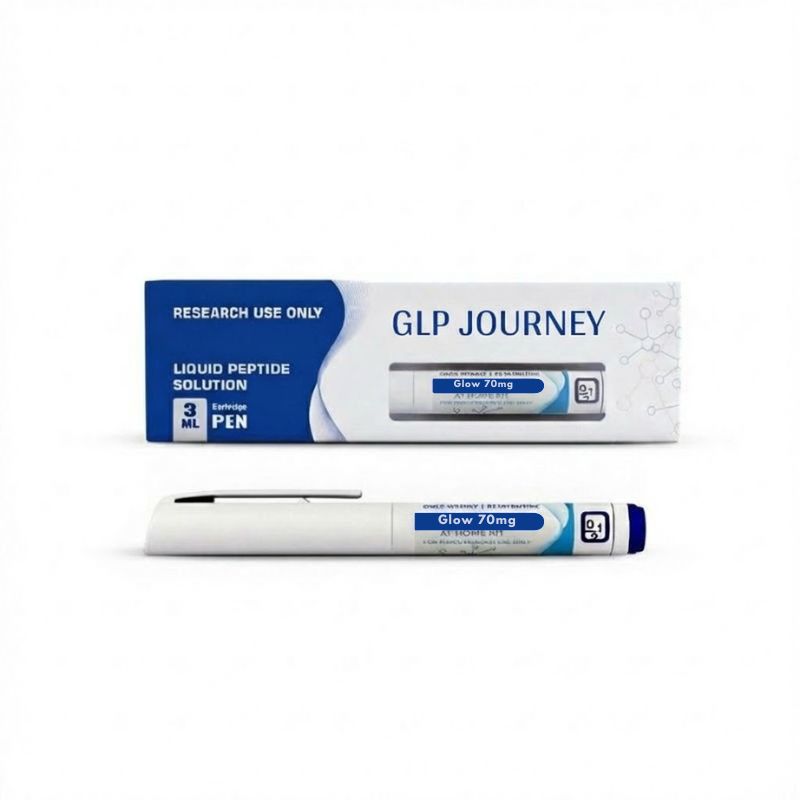
Glow 70mg
£209.00 Original price was: £209.00.£175.00Current price is: £175.00.
Glow 70 mg — Research Blend
GHK-Cu + BPC-157 + TB-500
70 mg total peptide content
– GHK-Cu 50 mg
– BPC-157 10 mg
– TB-500 10 mg
Supplied as white lyophilised powder in bacteriostatic water
Research use only
Glow is usually picked up once researchers stop looking at tissue behaviour in neat, isolated lanes.
Each of these peptides is familiar on its own. Most labs already know what GHK-Cu does. BPC-157 is well documented. TB-500 isn’t new either.
What changes with Glow is that none of them are acting alone.
This blend exists for situations where the question isn’t “what does this signal do?” but “what happens when several repair-related signals are present at the same time?”
One researcher described it during a project review like this:
“Individually, everything behaved. Together, things got more realistic.”
That’s usually the appeal.
Why these three are studied together
GHK-Cu is commonly examined in relation to cellular signalling, matrix interaction, and general tissue condition. It’s often described as communicative rather than forceful.
BPC-157 tends to show up where localised response and signalling consistency matter. Researchers often use it when they want to understand how specific areas behave across repeated sessions.
TB-500 usually enters the picture when the scope widens — movement, adaptation, and broader tissue behaviour rather than one fixed point.
Studied separately, each answers a narrow question.
Studied together, they stop being tidy.
As one lab lead put it:
“Once you layer them, you start seeing why single-pathway explanations fall apart.”
What Glow is normally used to look at
Glow is rarely part of short-term work.
Most interest comes from longer observation periods, where gradual change matters more than immediate response. Researchers using it are often comparing baseline behaviour against behaviour under layered signalling.
In practice, Glow tends to appear in research focused on:
– how tissues respond under combined signalling
– differences between isolated and overlapping repair pathways
– pattern changes over time rather than instant shifts
– comparisons between unsupported and supported response models
Someone involved in a multi-week study summed it up simply:
“It wasn’t dramatic. It was consistent. That’s what made it useful.”
About the format
Glow is supplied as white lyophilised powder in bacteriostatic water.
That choice isn’t about convenience. It’s about control.
Most researchers using this blend already have established protocols. They’re not looking to experiment with preparation methods — they’re trying to remove preparation as a variable.
A lab coordinator put it bluntly:
“Once you trust your protocol, the last thing you want is the prep getting creative.”
Storage and handling
Nothing unusual here:
Store refrigerated at 2–8 °C
Do not freeze
Limit exposure to light
Use standard aseptic laboratory practice
Preparation, concentration, and use should follow your own documented research protocols and be recorded accordingly.
Common questions
Why combine GHK-Cu, BPC-157, and TB-500?
Because they cover different aspects of tissue-related signalling. Together, they allow researchers to observe overlap rather than isolated effects.
Is Glow a medicinal product?
No. It is not licensed, approved, or supplied as a medicine.
Who is this blend intended for?
Laboratories and researchers already familiar with peptide handling and structured research workflows.
Important notice
This product is supplied solely for laboratory research and analytical investigation.
It is not intended for human or animal use and is not supplied for diagnosis, treatment, or prevention of disease.
Responsibility for compliant handling, storage, and use rests entirely with the purchaser.
If you want the same treatment applied to another blend or strength, just send the name and price.