
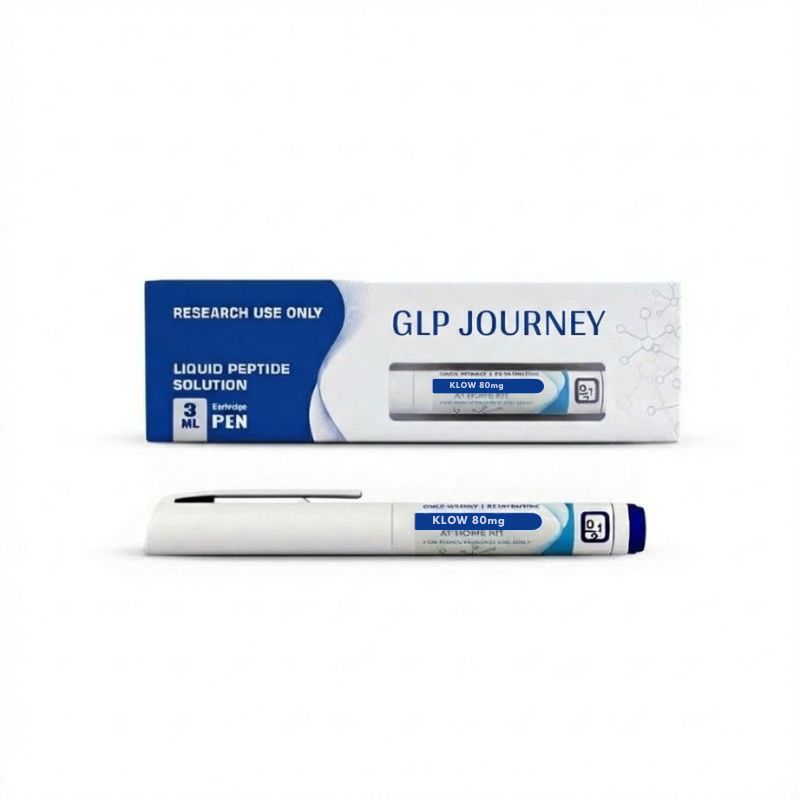
KLOW 80mg
£249.00 Original price was: £249.00.£199.00Current price is: £199.00.
KLOW STACK
Multi-Peptide Research Blend
Total peptide content: 80 mg
GHK-Cu — 50 mg
BPC-157 — 10 mg
TB-500 — 10 mg
KPV — 10 mg
Supplied as white lyophilised powder in bacteriostatic water
Research use only
KLOW Stack usually enters the picture once researchers have already spent time with each component on its own.
At that point, the question is no longer what does this peptide do?
It becomes what changes when several of these signals overlap?
That’s the gap KLOW is designed to sit in.
Rather than isolating tissue response, recovery signalling, or inflammatory modulation into separate models, this blend allows them to be observed together — at the same time, under the same conditions.
One researcher described the difference after switching from single-compound work:
“We stopped trying to stitch results together after the fact. Everything was already in the room.”
What’s actually going on inside the blend
Each component plays a different role, and none of them are there by accident.
GHK-Cu is often examined in relation to cellular signalling, matrix interaction, and general tissue condition. It tends to act more like a coordinator than a driver.
BPC-157 usually shows up when localised repair response and signalling consistency matter across repeated observations.
TB-500 is typically included when the scope broadens — movement, adaptation, and wider tissue behaviour rather than a single site.
KPV is commonly studied in relation to inflammatory signalling and modulation, particularly where inflammation appears to interfere with otherwise stable tissue response.
Individually, these peptides are tidy.
Together, they are not.
As one lab lead put it during a data review:
“Once KPV went in, the model stopped being just about repair. It became about control.”
How KLOW is normally used
KLOW Stack is rarely part of short-term work.
Most interest comes from longer timelines, where researchers are comparing baseline behaviour against behaviour under layered signalling rather than looking for immediate shifts.
In practice, it often appears in research focused on:
– how tissue responds when repair and inflammatory signals are present together
– differences between isolated pathways and overlapping systems
– gradual pattern changes rather than sharp responses
– stability of behaviour over time
A researcher involved in a multi-week project summed it up like this:
“Nothing jumped out early. But everything became easier to track.”
Why the format matters
KLOW Stack is supplied as white lyophilised powder in bacteriostatic water for one simple reason: control.
Most researchers using this blend already have defined protocols. They’re not interested in experimenting with preparation methods. They want to reduce variability, not introduce it.
A coordinator overseeing a long-running study said it plainly:
“Once the protocol’s set, prep should be invisible.”
Storage and handling
Nothing unusual or proprietary here.
Store refrigerated at 2–8 °C
Do not freeze
Limit exposure to light
Use standard aseptic laboratory technique
Preparation, concentration, and handling should follow internal research protocols and be documented accordingly.
Questions that usually come up
Why combine four peptides instead of studying them separately?
Because real systems don’t operate one pathway at a time. This blend allows overlap to be observed directly.
Is KLOW Stack a medicinal product?
No. It is not licensed, approved, or supplied as a medicine.
Who is this intended for?
Laboratories and researchers already familiar with peptide handling and structured research workflows, typically working with longer-term models.
Important notice
This product is supplied solely for laboratory research and analytical investigation.
It is not intended for human or animal use and is not supplied for diagnosis, treatment, or prevention of disease.
Responsibility for compliant handling, storage, and use rests entirely with the purchaser.